Russellville, AR
Safe Rooms in Russellville
Compare this shelter type and send an estimate request. Independent local installers can review your property.
Referral service. Shelters are sold and installed by independent local installers.
How safe rooms work
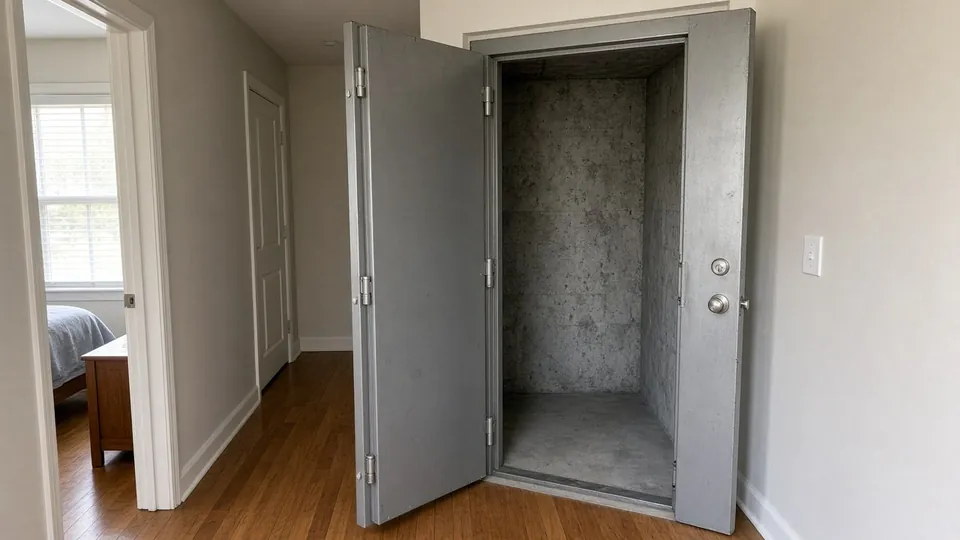
A safe room is an interior room built or reinforced to FEMA P-320 and ICC 500 criteria so it provides near-absolute protection from extreme wind. It often doubles as a closet, bathroom or pantry and is easiest to add while a new home is being built.
FEMA P-320 gives designs for safe rooms built with reinforced concrete, masonry, or wood and steel walls, anchored to the foundation, with a tested door assembly. Because the room is inside the house, it can be reached in seconds.
New construction is where adding a safe room is most practical, because walls, anchoring and the door can be planned with the rest of the house. In an existing home a safe room can be retrofitted, but FEMA notes retrofits generally cost more than new construction.
Ask the builder or installer which FEMA P-320 design or ICC 500-tested product they use, how the room is anchored, and what documentation you will receive. FEMA does not approve or certify products, so be wary of anyone claiming a shelter is FEMA approved.
Why it matters in Russellville
Pope County has 30 tornadoes documented since 1950, according to NWS Little Rock, and the long-track tornado of February 5, 2008 killed five people near Atkins. A planned shelter gives a household somewhere to go when a warning is issued.
NWS Little Rock counts 30 tornadoes documented in Pope County since 1950, with 7 tornado deaths, and 2,478 tornadoes with 412 deaths statewide (NWS Little Rock: Arkansas tornadoes by county since 1950). Arkansas averages about 37 tornadoes a year (1991–2020, NWS Little Rock: Arkansas Weather Statistics for 2022). On February 5, 2008 a long-track tornado, later rated EF4, crossed Pope County and killed five people near Atkins (NWS Little Rock: Severe Weather on February 5, 2008), and on March 19, 2020 NWS Little Rock surveyed EF1 tornadoes near Hector and near Dabney and Smyrna (NWS Little Rock: March 19, 2020 tornado surveys).
What it costs
No official source publishes a price for this shelter type alone, and this site has no prices of its own. Published FEMA and FLASH ranges for safe rooms are shown below with their sources; installers quote your project after reviewing the property.
FEMA P-320, Taking Shelter from the Storm (5th ed., 2021) (Table II-3) lists average new-construction costs of about $6,300–$8,300 for an 8×8 ft safe room and $11,400–$13,600 for a 14×14 ft room. The FEMA residential safe room fact sheet gives about $8,000–$9,500 and $14,000–$17,000 for the same sizes. FLASH (Federal Alliance for Safe Homes) puts site-built and prefabricated safe rooms at roughly $3,000–$9,500 depending on size. Retrofits usually cost more; these are published ranges, not quotes.
| Cost factor | Why it matters | Price |
|---|---|---|
| Shelter type | Below-ground, garage floor, above-ground, safe room or prefabricated unit; each has different excavation, anchoring and material needs. | Quoted by the installer |
| Size and capacity | FEMA and FLASH ranges rise with floor area; plan for everyone in the household. | Quoted by the installer |
| New construction or retrofit | FEMA notes retrofits in existing homes generally cost more than building a safe room during construction. | Quoted by the installer |
| Site and soil | Excavation, groundwater, slab condition, drainage and access for delivery trucks. | Quoted by the installer |
| Doors, ventilation and testing | Tested door assemblies and ICC 500 documentation. | Quoted by the installer |
| Permits | Shelter permit rules for Russellville were not verified by this site; ask City of Russellville Planning & Development or your county. | Quoted by the installer |
| Your project | Estimate request. No verified local prices exist, so this site publishes none of its own. Published FEMA and FLASH ranges are on the cost page. | |
How the process works
You send an estimate request, it is shared with independent local installers, they review your property and give written quotes, and you decide whether to hire anyone. Check permits and ICC 500 testing before you sign. Each step is listed below.
Send an estimate request
Tell us your town or ZIP, the shelter type you are considering and whether it is a new build or an existing home.
Your request goes to Silvano Para
The operator of this site reviews it and, with your consent, shares it with independent local installers serving your area.
Installers contact you
They may ask about your lot, basement, garage slab or floor plan and arrange a visit to look at the location.
You compare written quotes
Ask each installer about ICC 500 testing, permits, anchoring, insurance and what is included.
You decide
You are never obliged to hire anyone. Any contract and payment are between you and the installer.
Where you can request it
Requests are accepted from Russellville and nearby towns. Dardanelle, Clarksville, Morrilton, Atkins and Pottsville each have their own page with county tornado facts and permit notes; installers confirm availability for your address before arranging a visit.
- Storm shelters in Dardanelle
- Storm shelters in Clarksville
- Storm shelters in Morrilton
- Storm shelters in Atkins
- Storm shelters in Pottsville
Other types of storm shelters
The same estimate request covers the other shelter types. If an installer finds another type suits your home better, such as a garage floor unit instead of an in-ground one, they can quote that instead. Compare them all before you decide.
Request Shelter Information
Estimate request. Independent installers set any price after reviewing your property.
Service Areas
Requests are accepted from Russellville and the surrounding Arkansas River Valley, and five nearby areas have their own page with county tornado facts: Dardanelle, Clarksville, Morrilton, Atkins and Pottsville. Independent installers confirm whether they cover your address before arranging any visit.
| Area | County | Population (2020) | Distance from Russellville | NWS warning office |
|---|---|---|---|---|
| Dardanelle, AR | Yell | 4,517 | about 7 miles (11 min) by road from Russellville | NWS Little Rock |
| Clarksville, AR | Johnson | 9,381 | about 26 miles (30 min) west on I-40 | NWS Little Rock |
| Morrilton, AR | Conway | 6,992 | about 27 miles (31 min) east on I-40 | NWS Little Rock |
| Atkins, AR | Pope | 2,859 | about 14 miles (17 min) east on I-40 | NWS Little Rock |
| Pottsville, AR | Pope | 3,140 | about 8 miles (15 min) east by road from Russellville | NWS Little Rock |
Population: 2020 Census via Wikipedia. Distances are approximate road distances from downtown Russellville. Coverage outside these areas depends on installer availability.
Map © OpenStreetMap contributors. The map shows the area only; there is no office or showroom.